
Cancelling—or even severely constraining—the Navy’s F/A-XX program would be a strategic mistake that the United States would feel most acutely in a peer conflict in the Western Pacific. While the Air Force’s F-47 NGAD fighter will be central to future air superiority, it is not a naval aviation substitute. The two aircraft are designed for different environments, concepts of operation, and campaign problems. Treating the F-47 as a plug-and-play replacement for F/A-XX risks creating a fleet of aircraft carriers that cannot credibly fight their way into, or survive inside, China’s anti-access/area-denial (A2/AD) envelope.
The F-47 is the centerpiece of the Air Force’s Next Generation Air Dominance “family of systems” and is optimized as a land-based, penetrating air-superiority platform. It is intended to replace the F-22 and act as a “quarterback” for large numbers of collaborative combat aircraft (CCAs) that perform scouting, electronic attack, and weapons delivery in highly contested airspace. The Air Force envisions a fleet of roughly 200 F-47s and over a thousand CCAs, operating from land bases across the Indo-Pacific, supported by tankers and theater command-and-control networks. This architecture makes sense for a service whose primary advantage is global basing and long-range air campaigns.
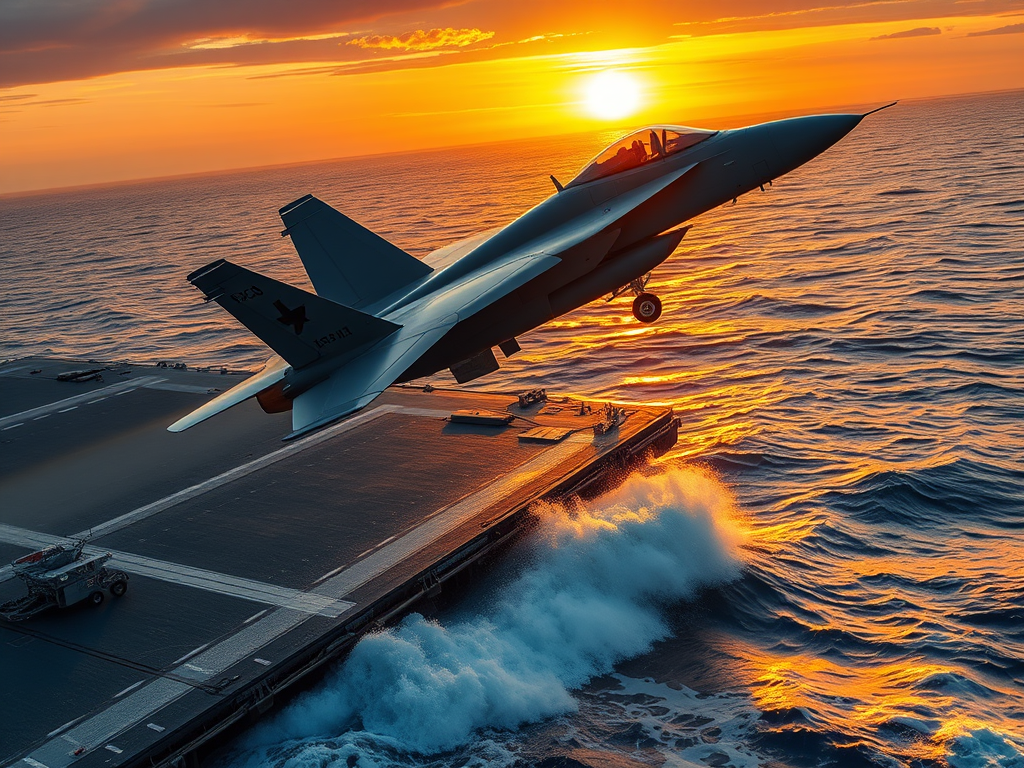
By contrast, the Navy’s F/A-XX is explicitly conceived as a carrier-based, sixth-generation air-dominance fighter designed to replace the F/A-18E/F Super Hornet and complement the F-35C in the 2030s. Public reporting indicates it will feature very low observability, greatly increased combat radius, networking with unmanned systems, and the ability to operate as the central air-dominance node for the entire carrier air wing. In other words, where the F-47 is the quarterback for a land-based NGAD “team,” F/A-XX is the quarterback for a carrier strike group: defending the carrier, punching holes in an integrated air defense system, and enabling follow-on strikes by F-35Cs, CCAs, and long-range missiles.
Simply adapting the F-47 to carrier use, as some Washington budgeteers have suggested, is not a trivial “navalization” exercise. Carrier aircraft face unique stresses from catapult launches, arrested landings, salt-water corrosion, and the need for low-speed handling and compact folding geometry on crowded decks. Those requirements ripple through the design: structural reinforcement, landing gear, wing loading, control surfaces, and even stealth shaping around launch and recovery hardware. Historically, attempts to navalize land-based fighters (e.g., the F-111B) have fared poorly, while fighters designed for carrier use from the outset (F-14, F/A-18, F-35C) embody different trade-offs than their Air Force cousins. F-47 is being optimized for range, altitude, and payload from long runways and tanker support—not for repeated traps at night on a pitching deck in the Philippine Sea.
The strategic context that justifies F/A-XX is China’s maturing A2/AD architecture. The People’s Liberation Army has invested heavily in long-range anti-ship ballistic missiles like the DF-21D and DF-26, with advertised ranges of roughly 1,500 km and up to 4,000 km respectively, specifically to hold U.S. carrier strike groups at risk if they approach the first island chain. That threat is backed by dense networks of surface-to-air missiles, advanced fighters, submarines, and over-the-horizon sensors. The answer to this environment cannot be to push carriers permanently outside missile range and hope land-based airpower can do the rest. That would concede sea control and crisis presence to Beijing. Instead, the Navy must extend the carrier air wing’s striking radius and survivability so that carriers can operate at tactically acceptable risk while still influencing the fight.
F/A-XX is tailored to that problem in ways the F-47 is not. Navy leaders have consistently emphasized that the next-generation carrier fighter must dramatically exceed the Super Hornet’s combat radius, provide its own stealthy penetrating capability, and integrate tightly with carrier-based drones and surface combatants. In practical terms, that means an aircraft able to: (1) escort and protect F-35Cs and CCAs on deep strikes, (2) conduct offensive counter-air against Chinese fighters and bombers threatening the carrier, (3) survive inside heavily contested airspace long enough to cue long-range ship- and air-launched missiles, and (4) do all of this from the moving, logistics-constrained “airfield” of a nuclear carrier. A land-based F-47, even if nominally “navalized,” would bring different performance and sustainment assumptions into that equation.
Cancelling or freezing F/A-XX in favor of the F-47 also creates a dangerous single-point-of-failure in U.S. high-end airpower. If both the Air Force and Navy rely on essentially the same airframe for sixth-generation air dominance, adversaries need only optimize their counter-stealth radars, missiles, and tactics against one design. The historical strength of U.S. airpower has been diversity: F-15s and F-14s, F-16s and F/A-18s, F-22s and carrier-borne Super Hornets. That diversity complicates enemy targeting and hedges against technical surprises. A world where the Air Force gets F-47 in numbers while the Navy is stuck with aging Super Hornets and small lots of F-35Cs, plus drones that remain dependent on fragile communications links, is a world in which the joint force’s air-dominance portfolio is dangerously shallow.
Proponents of cancelling F/A-XX often argue that unmanned systems can pick up the slack. But even the Air Force’s own internal study of NGAD concluded that a crewed sixth-generation fighter remains indispensable to achieving and sustaining air superiority in high-end fights; autonomous CCAs are enablers, not replacements. This logic applies even more strongly at sea, where communications are more easily jammed, satellites are at risk, and the fog and friction of naval warfare are intense. A carrier air wing composed of F-35Cs and drones without a dedicated, long-range F/A-XX leader risks losing the “brains” and on-scene judgment needed to orchestrate complex strikes and adapt when networks break down.
There is also an industrial and alliance dimension. The F/A-XX competition—now narrowed to Boeing and Northrop Grumman after Lockheed’s elimination —is the Navy’s highest-profile aircraft program in decades, a driver for the specialized skill sets needed to design, test, and build carrier-based stealth aircraft. Killing or indefinitely deferring it in favor of the F-47 would further concentrate design work in a single program, heightening the risk that a cost overrun or technical issue in NGAD cascades across both services. For allies like Japan and the UK that still bet heavily on carriers, the existence of a viable U.S. carrier-based sixth-gen fighter is a signal that the carrier concept itself remains credible in the missile age.
In a Pacific peer conflict—where distance, density of defenses, and the speed of escalation all favor the side that can quickly seize and hold the initiative in the air and at sea—betting solely on a land-based F-47 is strategically shortsighted. The F-47 and its CCA stable are necessary to kick down the door and maintain theater-wide air superiority. But without F/A-XX, the carriers that historically provide flexible power projection, crisis signaling, and maritime control become second-tier players, increasingly dependent on someone else’s air umbrella. The United States would be fielding the most advanced fighter in the world—and simultaneously accepting that its $13-billion supercarriers sail into harm’s way without a truly peer, purpose-built guardian.
For all these reasons, cancelling or severely constraining the F/A-XX program would not be smart “efficiency.” It would be a bet that the Pacific war we get will look exactly like the spreadsheets on today’s budget briefs—and not like the messy, maritime-heavy campaign that China’s A2/AD strategy is explicitly designed to force upon us. The smarter hedge is clear: fully fund F-47 for the Air Force and F/A-XX for the Navy, and ensure that in any Pacific fight, both the land-based and sea-based pillars of American airpower bring true sixth-generation teeth.
Chicago-Style Bibliography
Aerospace Global News. “What We Know About F/A-XX Program.” November 23, 2025. Accessed December 2, 2025.
Breaking Defense. “Exclusive: Lockheed Out of Navy’s F/A-XX Future Fighter Program.” March 4, 2025. Accessed December 2, 2025.
Breaking Defense. “Navy May Select Next-Gen Fighter Design as Soon as This Week.” October 7, 2025. Accessed December 2, 2025.
Congressional Research Service. U.S. Air Force Next-Generation Air Dominance (NGAD) Fighter. IF12805. July 22, 2025.
Congressional Research Service. China Naval Modernization: Implications for U.S. Navy Capabilities. RL33153. Washington, DC, May 19, 2025.
European Security & Defence. “US Air Dominance: The Story So Far.” June 16, 2025.
National Security Journal. “No F/A-XX Fighter? U.S. Navy Aircraft Carriers Would Be in a World of Trouble.” September 5, 2025.
National Security Journal. “The F/A-XX 6th Generation Navy Stealth Fighter: The Inside Story.” October 10, 2025.
National Security Journal. “The U.S. Air Force Has a F-47 NGAD Fighter Math Problem.” November 29, 2025.
U.S. Air Force. “Air Force Awards Contract for Next Generation Air Dominance (NGAD) Platform F-47.” News release, March 21, 2025.


Leave a Reply