
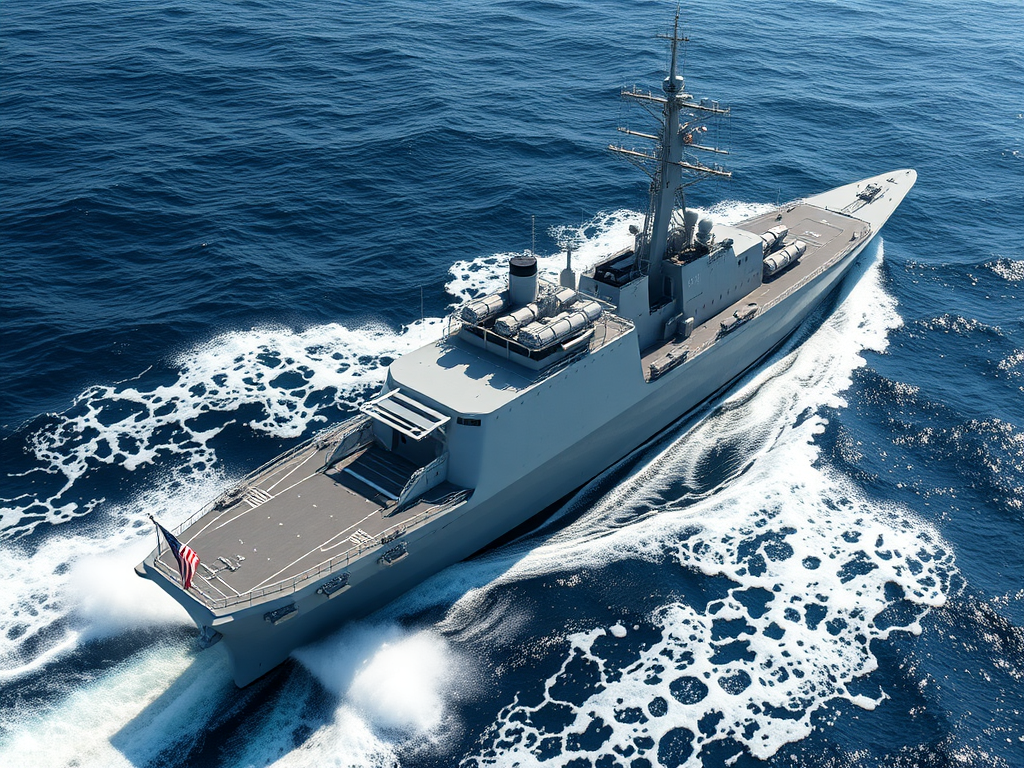
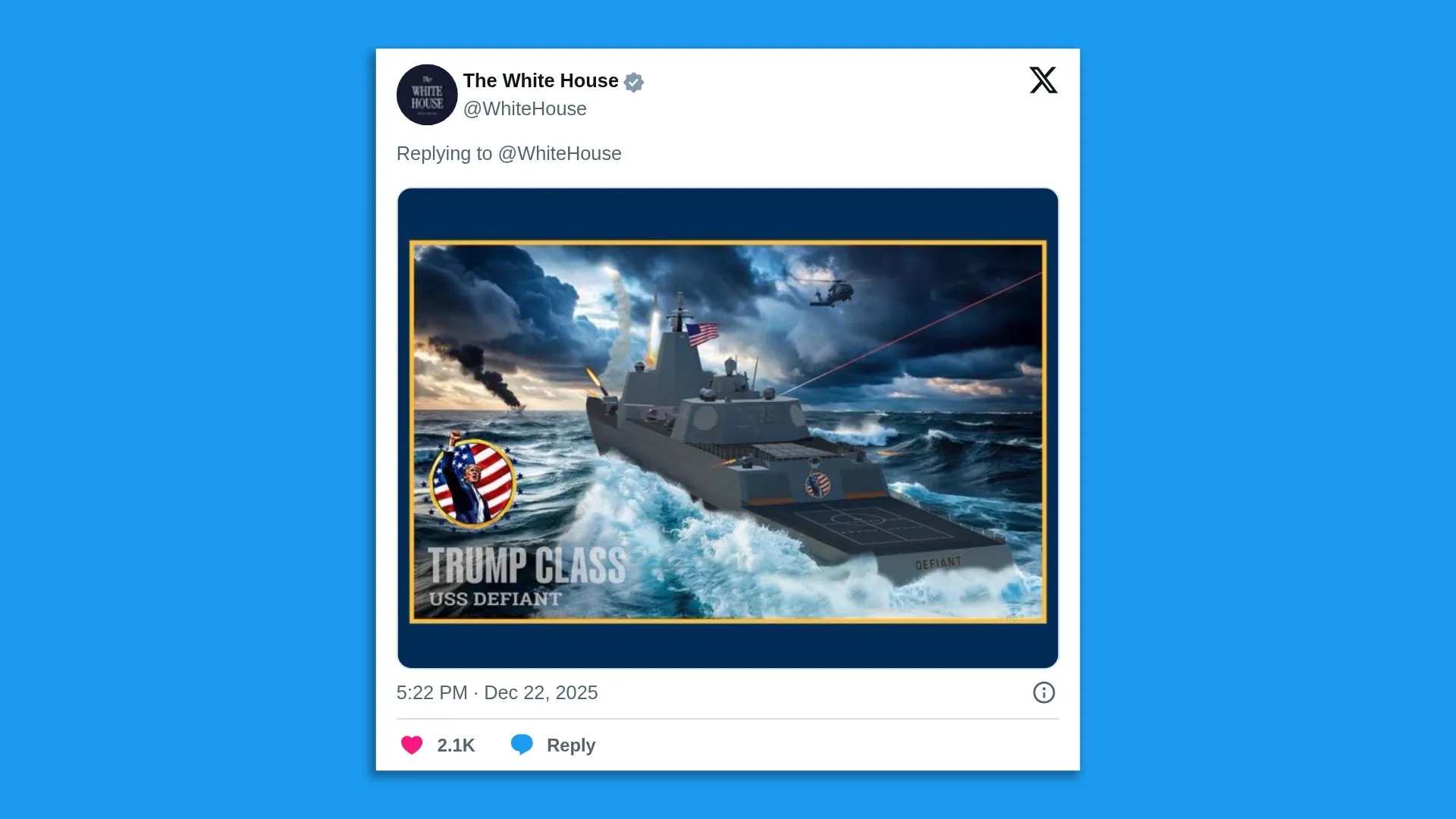
The Navy’s sudden and surprising pivot toward a new frigate derived from the Coast Guard’s Legend-class National Security Cutter (NSC) is, at heart, a schedule-and-risk decision: pick a proven U.S.-built hull with an existing design pedigree, then “navalize” it fast enough to get a ship “in the water” by 2028—the public goal Navy leadership has now put on the table.
Why the Legend-class hull is attractive (and what it is, physically)
The Legend-class NSC is a large, ocean-going cutter designed for long endurance patrols. In Coast Guard program fact sheets, the NSC is listed at 418 feet in length, about 4,500 long tons displacement, 28 knots max speed, and roughly 12,000 nautical miles range with 60–90 day patrol cycles—exactly the kind of “sea-keeping and legs” that make a good escort baseline.
That baseline hull is also meaningfully smaller than the (now-canceled in quantity) Constellation-class: the Navy’s own fact file gives Constellation at 496.1 feet and 7,291 long tons displacement.
So, in round numbers: NSC ~418 ft / ~4,500 tons vs Constellation ~496 ft / ~7,300 tons—a sizable gap in volume for sensors, power, and weapons, but also a gap in cost/complexity the Navy is clearly trying to avoid repeating. This program will not be allowed to bloat into a light destroyer. The navy will work within these constraints- we will demonstrate how, below.
This isn’t a brand-new idea. Huntington Ingalls/Ingalls has been pitching patrol frigate concepts derived from the NSC hull for years, and Ingalls’ NSC-derivative concepts were repeatedly discussed as candidates for Navy small-combatant needs.
Publicly described Ingalls patrol-frigate variants (often summarized as “PF” concepts) give a reasonable picture of what an NSC-based Navy frigate might carry:
Vertical launch cells: Ingalls described a concept with a 12-cell VLS paired with a 76mm gun, plus added ASW/ASuW features (anti-ship missiles and torpedoes) and sonar additions. Heavier combat fit in Navy framing: USNI reporting on the earlier “super-duper” Ingalls patrol frigate concept noted a version “based upon the NSC” featuring a 16-cell VLS.
Put plainly, the prior NSC-derivative pitch was not “Constellation in disguise.” It looked more like a mid-tier escort: enough VLS to contribute to local air defense (likely ESSM-class loads), plus deck-launched anti-ship missiles, torpedoes, and an ASW sensor package (hull sonar/towed array in concept imagery and writeups).
How the Navy could (and probably would) improve it
If the Navy really wants this to be a true frigate and not simply a “better cutter,” the likely improvements are straightforward—because they’re the same knobs the Navy has been turning on every escort in the missile age:
More VLS (or better VLS integration) A 12–16 cell VLS is credible for a “self-defend + point defense” escort, but it is thin for modern distributed fights. The Navy could stretch the hull (or reconfigure forward decks) to accept Mk 41 VLS in larger counts, but every added cell drives naval-architecture changes (weight, stability, services, shock, etc.). The Navy has acknowledged in other contexts that growing VLS count is non-trivial and forces redesign work. A Navy-grade combat system and radar fit The cutter already has modern C2 and aviation facilities, but a Navy frigate would need tighter integration into fleet air defense and cooperative engagement networks. Whether that becomes an Aegis-family baseline or another architecture, the integration effort—not the bare hull—often becomes the pacing item. ASW “completeness” The NSC has the space/endurance to support aviation and mission systems, but an escort frigate must be able to find and track submarines routinely. The concept path most often described for the Ingalls patrol-frigate family includes hull sonar and towed array additions.
The unmanned surface vessel “adjunct magazine” advantage: more shots without bloating the ship
Where an NSC-derived frigate could get truly interesting is pairing it with unmanned surface vessels (USVs) to solve the classic frigate problem: magazine depth.
The Navy has been explicit that Large Unmanned Surface Vessels (LUSVs) are envisioned to provide “adjunct missile magazine” capacity in support of Distributed Maritime Operations.
In practical terms, a frigate that might only carry (say) a few dozen VLS cells could deploy with an unmanned companion that carries additional launch capacity (or containerized missile payloads) and is networked into the task group. The manned frigate supplies:
high-quality sensors and command judgment, secure comms and tactical control, organic aviation and boarding/search capability,
The USV supplies extra missiles—the difference between “one good engagement” and “staying in the fight.”
There are real constraints (rules of engagement, positive control, cyber and comms hardening, and the question of how autonomous a shooter is allowed to be), but the concept is attractive precisely because it lets the Navy avoid turning the frigate itself into a mini-destroyer just to carry more missiles. This approach has failed, and was not seen as value when comparing “bang for the buck”.
Can it really deploy by 2028?
The Navy’s stated ambition is “in the water” in 2028—that is a careful phrase: it implies launch or float-out, not necessarily a fully tested, fully combat-certified deployment.
Even so, 2028 is aggressive. The best argument for it is that the NSC is a mature, U.S.-built parent design with known production history, reducing “first-in-class hull” surprises.
The best argument against it is that navalizing a cutter into a true fleet escort means combat system integration, shock/survivability changes, sensors/weapons redesign, and testing—and those are exactly the areas that have historically turned “quick derivatives” into long schedules.
The timeline is aggressive: a launch by 2028 is plausible if requirements stay tight and the Navy treats it as a disciplined derivative, but an operational deployment by 2028 is much less likely impossible.
In a nutshell:
Constellation is in all senses, a mini-destroyer.
The NSC-derived frigate + USVs is a distributed system. Distributed systems is the future of warfare.
Operational Use Case (Why This Works)
Escort duty: Convoys, amphibs, logistics groups Distributed Maritime Ops: Sensors forward, shooters dispersed Indo-Pacific reality: Numbers, endurance, and reload access matter more than exquisite single hulls Survivability: Losing a USV is tactically painful, not strategically catastrophic
This pairing also aligns with Navy thinking that future surface combatants must fight as networks, not as individual ships.
Is the timeline possible?
Hull & propulsion: Proven → low risk Combat system: Moderate risk, manageable with constrained requirements Weapons: All systems already in Navy inventory USVs: Already under active development and testing
Conclusion:
A basic frigate loadout by 2028 is plausible.
A fully mature USV-integrated missile ecosystem will likely follow in the early 2030s—but early operational pairings are realistic.
Bibliography
Breaking Defense. “Navy Wants New Frigate in 2028, Says Service’s Acquisition Head.” December 2025.
DefenseScoop. “Navy Issues New RFI for Large Unmanned Surface Vessel.” November 6, 2023.
Huntington Ingalls Industries. “Ingalls Shipbuilding Highlighting Patrol Frigate Derivative of National Security Cutter at DIMDEX.” March 2012.
Naval Sea Systems Command (NAVSEA). “U.S. Navy Successfully Completes Large Unmanned Surface Vessel Testing Milestone.” December 20, 2023.
United States Coast Guard, Directorate of Acquisition (CG-9). National Security Cutter (NSC) Fact Sheet. October 2022.
United States Navy. “Constellation Class (FFG) Fact File.” January 31, 2024.
United States Naval Institute News. “Navy Slowing Frigate Procurement to Allow Careful Requirements Talks; Contract Award Set for FY2020.” May 3, 2017.
Trevithick, Joseph. “U.S. Navy Now Wants A New Frigate And Fast.” The War Zone (The Drive), December 12, 2025.


Leave a Reply