
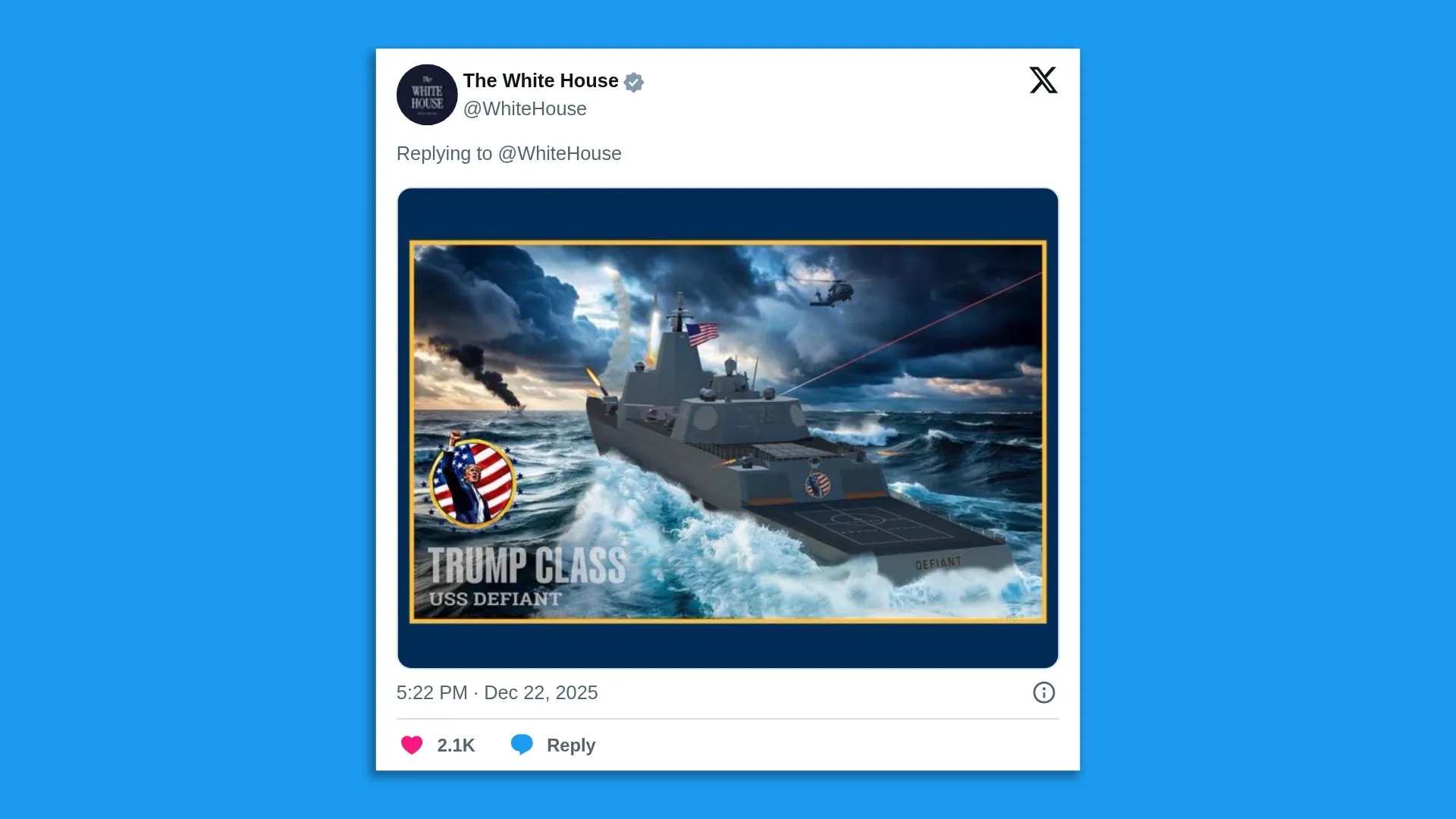
President Donald Trump announced on December 22, 2025 that he wants the U.S. Navy to pursue a new class of very large surface combatants he labeled the “Trump-class”—described in press coverage as “battleships” and rolled out as part of a broader “Golden Fleet” initiative. The public details so far come from the announcement itself and early reporting: the initial tranche would begin with two ships (with Trump and senior officials floating a much larger eventual total), and the concept is presented as a dramatic revival of big-gun naval prestige—while also promising modern payloads like missiles and directed-energy systems.
A “battleship” pitch as leverage for a cruiser replacement problem
If you strip away the branding and the nostalgia, there’s a real Navy force-structure gap that the announcement can be (politically) mapped onto: the retirement of the Ticonderoga-class (CG-47) cruisers and the long-running search for a replacement that restores cruiser-like air-defense command-and-control capacity and growth margin for future sensors and weapons. In Congress’s and the Navy’s official framing today, the program meant to replace the Ticonderogas is DDG(X)—a next-generation large surface combatant envisioned to enter procurement in the early 2030s.
That matters because a president who plainly enjoys the symbolism of “battleships” can use that affection to sell (or at least rebrand) a very expensive large-surface-combatant recapitalization that otherwise reads like technocratic shipbuilding: radar apertures, combat-system baselines, VLS cell counts, power margins, and staffing. The political theory here is straightforward: calling something a “battleship” can be a messaging shortcut for “dominant, survivable, heavily armed surface flagship,” which overlaps with what cruiser replacement advocates want—especially if they worry DDG(X) will be stretched, delayed, or under-bought. (That is an interpretation of the politics, not a claim about a signed acquisition plan; the only confirmed public fact at this stage is the announcement and intent to pursue a “Trump-class.”)
Why this should not be allowed to cannibalize F/A-XX and carrier aviation
The risk isn’t just sticker shock; it’s opportunity cost inside a finite defense topline and within Navy priorities. The Navy’s F/A-XX effort—its next-generation carrier-based fighter intended to replace F/A-18E/F (and complement the F-35C)—is a centerpiece of future carrier aviation and the broader Navy “family of systems” approach to contested-range problems. Reuters reporting in 2025 describes senior-level decisions around the program and expectations that it will bring improved range, endurance, stealth, and integration with uncrewed systems—exactly the attributes carrier air wings need as adversary air defenses and anti-ship kill chains improve.
A “Trump-class” initiative, if pursued as described, would be capital-intensive (and politically loud). That combination can create pressure to “pay for” big hulls by squeezing less visible (but strategically central) aviation R&D, testing, and procurement. The Navy should resist that dynamic for a simple operational reason: in modern maritime war, carriers and their air wings remain the Navy’s principal means of generating scalable, mobile combat power at range—and a future carrier air wing that doesn’t get the range/survivability leap promised by F/A-XX is a fleet-wide vulnerability no single surface combatant class can compensate for. Put bluntly: the most dangerous trade is swapping the long-term health of carrier aviation for a near-term political win in ship naming and spectacle.
Railguns, Japan, and what “collaboration” can realistically mean
On railguns, the factual baseline is: Japan is actively pursuing shipborne electromagnetic railgun development and testing, including installing a turreted system on the test ship JS Asuka and conducting at-sea trials. Multiple reports also note that Japan’s acquisition agency has engaged with U.S. Navy officials about leveraging prior U.S. railgun work—after the U.S. effort was shelved—suggesting at minimum a pathway for technical exchange, lessons learned, and component-level collaboration. Separately, Reuters has described U.S.–Japan defense R&D cooperation in which Japan’s railgun interest sits in a wider missile-defense and advanced-tech context, underscoring that railgun work is part of an allied innovation ecosystem rather than a standalone gimmick.
How would that benefit new ships in practical terms—especially a notional “Trump-class” that reportedly name-checks railguns? The main benefits are not magic “superweapons,” but the hard, enabling pieces: power generation and storage, thermal management, barrel/rail durability, fire-control integration, and a supply chain for specialized materials. Railgun development forces progress on exactly the ship-design margins (power and cooling) that also support high-end sensors and lasers. If the U.S. Navy truly wants large surface combatants with meaningful directed-energy and advanced gun concepts, Japan’s continued testing and the prospect of structured cooperation offers a way to reduce technical risk by learning from a partner that is still running experiments at sea.
Bottom line
As of December 2025, “Trump-class” is best understood as a high-profile political announcement intersecting with a real Navy modernization need: replacing cruiser capacity while building ships with enough growth margin for next-generation weapons. But the Navy should treat it as additive only if it does not raid the accounts and attention needed for F/A-XX and carrier aviation, which underpin fleet lethality across scenarios. Meanwhile, railgun “collaboration with Japan” is most credibly framed today as ongoing Japanese at-sea development plus engagement with U.S. Navy stakeholders—a real opportunity for risk-reduction and engineering learning, but not a substitute for sober requirements, budgets, and test discipline.
bibliography
Cancian, Mark F., and related commentary quoted in: Lamothe, Dan, and Tara Copp. “Trump unveils a new class of Navy battleship named after himself.” The Washington Post, December 22, 2025.
Congressional Research Service. “Navy DDG(X) Next-Generation Destroyer Program.” CRS In Focus IF11679, December 4, 2025.
Reuters. “Trump unveils plan for ‘Trump-class’ battleships to boost US sea power.” December 22, 2025.
Reuters. “Pentagon’s Hegseth okays US Navy next-generation fighter, sources say.” October 7, 2025.
Reuters. “US, Japan vow more defense cooperation to counter China.” January 7, 2022.
Trevithick, Joseph. “Railgun Installed On Japanese Warship Testbed.” The War Zone, April 18, 2025.
Trevithick, Joseph. “Railgun Damage To Japanese Target Ship Seen For The First Time.” The War Zone, November 13, 2025.
USNI News. “Japan Tests Railgun at Sea; Repositions V-22 Osprey Fleet.” April 21, 2025


Leave a Reply