
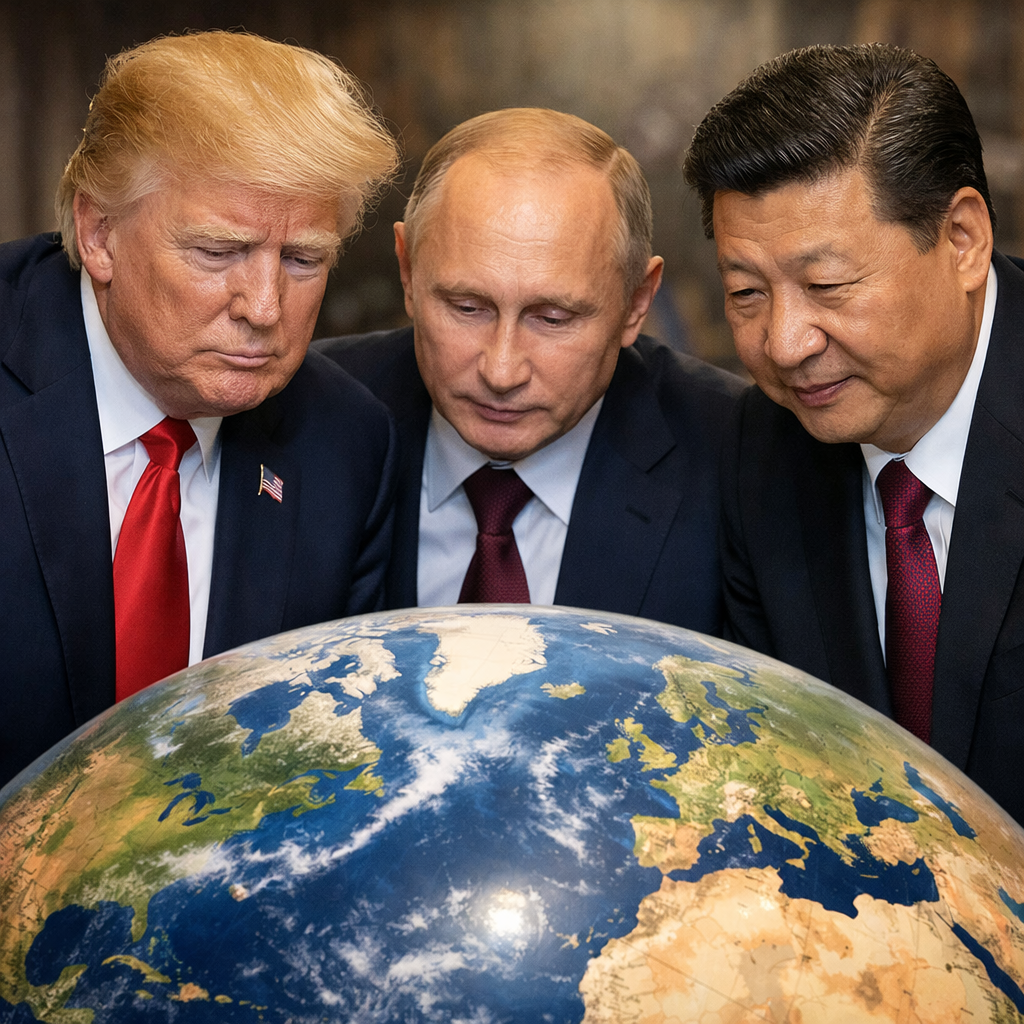
The reported U.S. military operation on January 3, 2026 to seize Venezuelan leader Nicolás Maduro (described by U.S. officials as a law-enforcement–linked action to enforce U.S. criminal charges) is more than a Latin America shockwave—it lands directly on two great-power fault lines: U.S.–China and U.S.–Russia. Because the operation appears to have combined kinetic force, a leadership decapitation, and an extradition-style transfer, it is already being framed globally as a test case for sovereignty, international law, and spheres of influence.
U.S.–China: From “competition” to precedent anxiety
Beijing’s initial posture has been blunt: Chinese statements and reporting emphasize “shock,” condemnation, and the claim that Washington violated international law—and they have highlighted that Venezuela is a sovereign state and a Chinese partner. That reaction is not only ideological; it is strategic.
1) The Taiwan narrative problem (and opportunity) for Beijing.
Even if China’s material equities in Venezuela are smaller than headlines suggest, the precedent matters. Commentators are already noting that China may cite the Venezuela operation as rhetorical ammunition in future arguments about “Western hypocrisy” on sovereignty—especially in contexts like Taiwan, where Beijing insists the issue is internal while many U.S. allies emphasize deterrence and norms. From Beijing’s perspective, a U.S. operation that removes a head of state by force undercuts Washington’s ability to speak cleanly about “rules-based order,” even if Washington argues the target was uniquely criminalized (narco-terrorism framing) or that it was acting to protect regional stability.
2) China’s Latin America strategy: less retreat than rerouting.
China is widely described as Venezuela’s major external partner through oil trade and prior lending arrangements, and recent reporting stresses that Beijing has sought to protect its interests while avoiding direct military entanglement. The capture of Maduro threatens Chinese influence politically (new authorities may rebalance toward the U.S.), but it also creates incentives for Beijing to insure its position in other Latin American states—through diplomacy, trade, infrastructure, and security cooperation—rather than attempting a high-risk showdown over Caracas.
3) Sanctions, energy flows, and the “who gets paid” question.
Venezuela’s oil—and the country’s heavy-crude exports to Asia—sits in the middle of any near-term economic fallout. Reuters reporting highlights that Venezuela holds massive reserves, exports have skewed toward Asia in recent years, and debt and oil-linked arrangements remain part of the story. If a U.S.-backed transitional authority tries to restructure PDVSA relationships, revisit contracts, or prioritize Western firms, Beijing will worry about repayment streams, contractual stability, and whether U.S. financial pressure becomes the real lever.
Bottom line for U.S.–China: expect sharper diplomatic friction, louder propaganda about sovereignty, and heightened Chinese sensitivity to “regime-change-by-raid” as a precedent—without China necessarily escalating militarily. The impact is less “China will fight for Maduro” and more “China will use this to contest U.S. legitimacy and hedge harder across the region.”
U.S.–Russia: Condemnation now, exploitation later
Moscow’s response (as reported) has included condemnation and calls for Maduro’s release, portraying him as Venezuela’s legitimate leader. That line fits Russia’s broader foreign-policy reflex: resist U.S. interventions, defend sovereignty language when useful, and emphasize Western double standards. But Russia’s deeper play is likely to be narrative leverage—especially regarding Ukraine.
1) Ukraine messaging: “You did it too.”
Analysts are already forecasting that Russia will point to the Venezuela operation to justify or whitewash its own conduct in Ukraine—arguing that Washington uses force across borders when it wants outcomes, so Russian actions should not be uniquely condemned. Even if the cases are not morally or legally equivalent, Moscow thrives on muddling categories and eroding consensus.
2) A stress test for U.S.–Russia crisis channels.
Reuters reporting notes Trump said Maduro did not come up in a call with Putin around the same period, which suggests either compartmentalization or a desire to avoid immediate linkage between theaters. Still, Moscow may probe for concessions: if Washington wants calmer seas in the Western Hemisphere after a controversial operation, Russia can hint that it can raise costs elsewhere—cyber, information ops, energy diplomacy, or diplomatic obstruction.
3) Limited Russian capacity, but persistent spoiler power.
Russia has historical oil and arms ties to Venezuela and has supported Caracas partly as a way to needle U.S. influence in the hemisphere. Yet Russia’s bandwidth is constrained by the Ukraine war and sanctions. That makes it less likely to mount a costly rescue of Venezuelan allies—and more likely to apply cheap pressure: UN theatrics, disinformation, and selective escalation in other arenas.
Bottom line for U.S.–Russia: relations were already adversarial; this operation gives Moscow fresh rhetorical ammunition and potential bargaining chips, but not necessarily a new alliance architecture. The biggest “effect” is likely indirect: it may weaken international cohesion against Russia by muddying norms and complicating allied messaging.
The combined effect: Beijing and Moscow align—mostly in words
One underappreciated consequence is that the Venezuela operation gives China and Russia a low-cost convergence point: joint emphasis on sovereignty, UN Charter language, and condemnation of unilateral force. That doesn’t mean a coordinated counterstrategy; it means a coordinated message that can sap U.S. legitimacy among nonaligned states.
For Washington, the strategic trade is stark: removing Maduro may create leverage in Venezuela and signal resolve, but it also risks increasing distrust with China, handing Russia a narrative weapon, and forcing U.S. allies to choose between pragmatic quiet support and principled discomfort about international law.
Chicago-Style Bibliography
Associated Press. “What We Know About a US Strike That Captured Venezuela’s Maduro and What Comes Next.” AP News, January 3, 2026.
Axios. “World Leaders Denounce U.S. Operation to Capture Maduro.” Axios, January 3, 2026.
Chatham House. “US to ‘Run’ Venezuela After Maduro Captured, Says Trump: Early Analysis.” Chatham House, January 2026.
The Guardian. “Is There Any Legal Justification for the US Attack on Venezuela?” The Guardian, January 3, 2026.
Reuters. “Trump Says He’s ‘Not Thrilled’ with Putin Over War in Ukraine.” Reuters, January 3, 2026.
Reuters. “Venezuelan Oil Industry: World’s Largest Reserves, Decaying Infrastructure.” Reuters, January 3, 2026.
The Washington Post. “China Condemns U.S. Strike in Venezuela, Hours After Diplomat Met with Maduro.” The Washington Post, January 3, 2026
Leave a Reply